:format(webp))
:format(webp))
Why You Might Still Write Code as a Founder in 2025
By reading this, you’ll see the classic benefits of hands-on coding, how AI and no-code platforms are reshaping the founder’s toolkit, and which non-coding abilities can make or break your next startup.
Staying Close to Your Product Vision
Writing code yourself helps you sense real-world constraints early on. When you touch the codebase, you’ll:
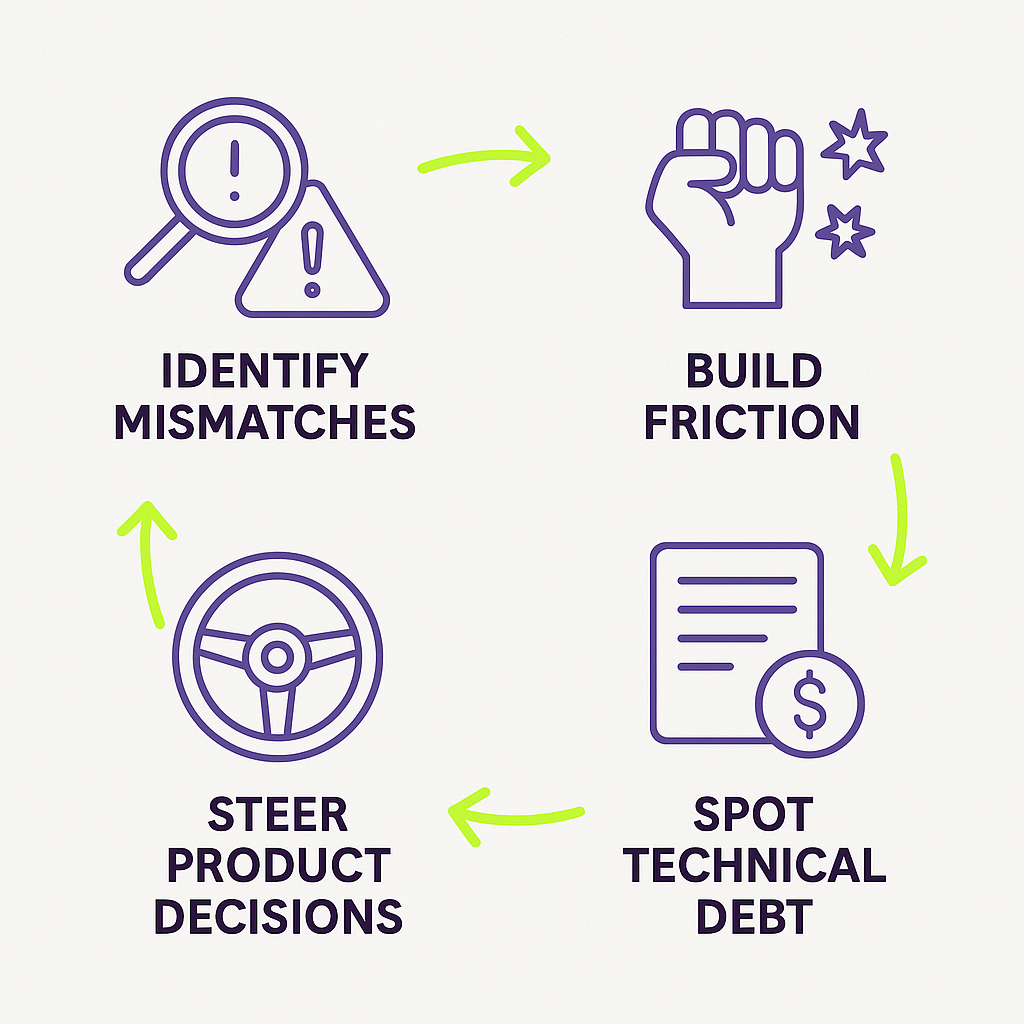
Spot mismatches between feature specs and actual behavior
Prioritize fixes once you feel the friction of a slow build
Understand where technical debt lives and how it grows
These insights let you steer product decisions with first-hand knowledge rather than slides or summaries.
Building Credibility and Culture
Engineers trust founders who can dive into code reviews and share pull request comments. You gain:
Respect by tackling a tricky bug in their language
A platform to mentor juniors through real examples
An atmosphere where every team member feels heard
Mentorship Through Example
Richard Nishikawa writes, “When you write code alongside your team, you show that you’re invested in both product and people”.
Accelerating Learning and Time to Market
In the earliest days, coding your own prototype can be the fastest way to validate an idea. Steve Blank notes that hands-on development lets you iterate far more rapidly than hand-waving specs to contractors.
Navigating the Rise of AI-Assisted Tools
Tools like GitHub Copilot or Tabnine can auto-generate boilerplate, letting you sketch features with minimal syntax work. That means non-technical founders can now:
Prototype front-end flows without deep React knowledge
Spin up simple data pipelines via AI suggestions
Move from zero to demo in hours, not days
According to GitHub, Copilot surpassed 1 million users by late 2022.
Watch Out for Machine-Generated Pitfalls
Relying on AI-written code adds layers of review:
You must vet each snippet for security holes
Unexpected dependencies may sneak in
Overly generic code can bloat your app
Always treat AI output as a draft to refine.
Embracing No-Code, Low-Code, and “Vibe Coding”
Platforms like Bubble or Adalo let you build entire MVPs by dragging elements and writing plain-English logic. By 2026, Gartner predicts 65% of application development will use low-code or no-code tools.
Solo Entrepreneurs Go Farther
You no longer need a five-person dev team just to launch a site or simple mobile app. A solo founder can:
Stitch together user auth, payments, and dashboards
Test multiple landing pages without touching HTML
Pivot in hours when metrics point elsewhere
Skills That Matter Beyond Typing Code
As automation handles more syntax, these qualities set founders apart:
Design thinking : crafting user flows that feel intuitive
Emotional intelligence : reading team morale and customer feedback
Business acumen : spotting partnerships, pricing lanes, revenue models
Storytelling : weaving data into a pitch investors remember
Skill | Description |
|---|---|
Crafting user flows that feel intuitive | |
Reading team morale and customer feedback | |
Spotting partnerships, pricing lanes, revenue models | |
Weaving data into a pitch investors remember |
“As Steve Blank puts it, ‘The fastest way to learn is to code yourself,’ but the best way to scale is to understand people”.
Writing the Next Chapter
Whether you keep typing or hand over most tasks to AI and no-code platforms, your deep product insight and leadership will remain the hardest parts to replace. By blending some hands-on coding, smart use of emerging tools, and a sharpened focus on human-centered skills, you’ll chart a path that’s uniquely yours—and one that technology can’t simply duplicate.
:format(webp))
:format(webp))
:format(webp))