:format(webp))
:format(webp))
How to Hire React Developers: A Practical Guide for 2025
When you’re ready to bring a React developer onto your team, you want someone who not only knows the basics but can also tackle complex challenges—from boosting performance to ensuring security. In this guide, you’ll learn how to define your needs, spot the right technical and soft skills, find candidates in unexpected places, assess them rigorously, and set them up for long-term success.
Defining Your Project Requirements
Before you post a job ad or reach out to agencies, get crystal clear on what your project demands.
1. Outline the scope
Feature set (single-page app, dashboard, micro-frontends)
Integrations (APIs, third-party services)
Expected traffic or performance targets
2. Identify must-have technologies
React fundamentals (hooks, context)
State management (Redux, Zustand)
Testing frameworks (Jest, React Testing Library)
Advanced performance techniques like code splitting, memoization, and lazy loading, which can reduce bundle sizes by up to 30% in large apps ( React documentation on code splitting ).
3. Set a budget and timeline
A clear budget range helps you gauge candidate seniority and availability. Define milestones such as prototype, alpha, and production launch.
Key Skills to Look For
Core Technical Skills
JavaScript proficiency (ES6+ syntax, async/await)
Deep understanding of React fundamentals (components, props, state)
Experience with state management libraries
Familiarity with testing and CI/CD pipelines
Advanced Technical Skills
Server-Side Rendering (SSR): Experience with Next.js or Remix to improve SEO and initial load performance ( Next.js pages documentation ).
TypeScript in React: Improves maintainability and catches type errors at compile time, leading to fewer runtime bugs ( TypeScript official website ).
Performance Optimization:
Code splitting with `React.lazy`
Memoizing expensive renders using `React.memo` and `useMemo`
Lazy loading images and components
Security Best Practices:
Avoid `dangerouslySetInnerHTML` or sanitize inputs
Implement Content Security Policy (CSP) headers
Validate and escape user input to prevent XSS ( OWASP React Security project ).
Soft Skills
Clear communication (explaining technical trade-offs)
Problem-solving under pressure
Collaboration in remote or cross-functional teams
Adaptability to shifting requirements
Where to Find Top React Talent
You’ll discover strong candidates in familiar spots—and some you might not expect:
Traditional job boards (LinkedIn, Indeed)
Developer marketplaces (Toptal, Upwork)
GitHub and open-source projects—evaluate their contributions and issue-tracking activity
React-specific communities (Reactiflux Discord, r/reactjs subreddit)
Technical meetups and conferences (React Summit, JSConf)
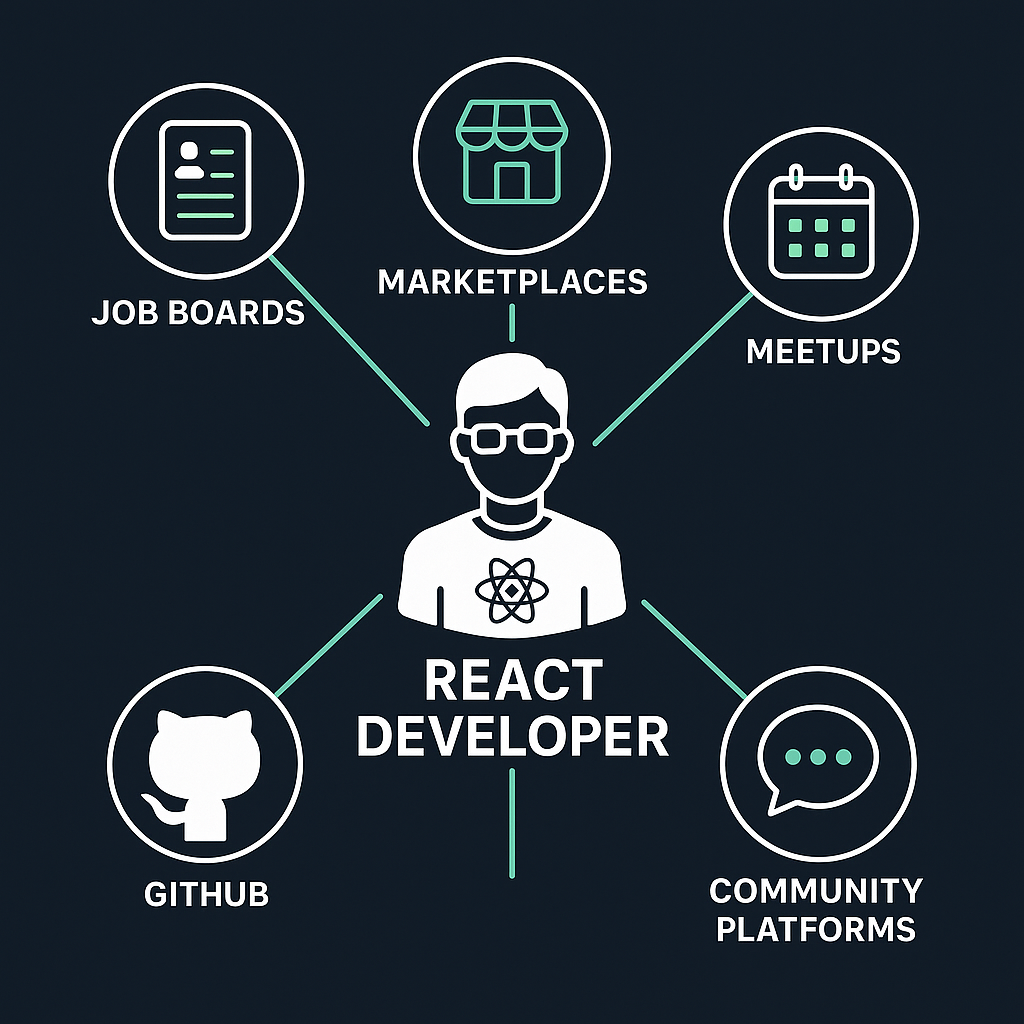
According to the 2021 GitHub Octoverse report , 53% of hiring managers consider open-source contributions when evaluating a developer’s expertise.
How to Evaluate Candidates
Resume and Portfolio Screening
- Look for real-world projects, links to live apps, and open-source repositories.
Technical Interview
- Ask about past React projects, challenges faced, and decisions made.
- Sample question: “How would you optimize a 2 MB bundle for mobile users?”
Coding Challenge or Pair Programming
- A small take-home task (e.g., build a search component with debounced API calls) or live coding session.
Culture and Collaboration Fit
- Discuss how they handle feedback, remote communication, and sprint retrospectives.
Step | Purpose | Format |
|---|---|---|
Resume and Portfolio Screening | Assess candidate experience through real-world projects and portfolios | Resume review, links to live apps/repos |
Technical Interview | Evaluate problem-solving, technical depth, and past project experience | Structured interview with practical questions |
Coding Challenge or Pair Programming | Test coding ability and workflow under pressure | Take-home task or live coding session |
Culture and Collaboration Fit | Determine alignment with team culture and collaboration style | Discussion around feedback, communication, retros |
Onboarding and Retaining React Developers
Your new hire’s first weeks set the tone for loyalty and productivity:
Provide a structured onboarding checklist (access to repos, coding standards, environment setup)
Assign a peer mentor for code reviews and architectural discussions
Schedule regular knowledge-sharing sessions on topics like performance and security
Offer clear growth paths: attending conferences, obtaining certifications, contributing to open-source
Building Your Dream React Team
Bringing on the right React developer means looking beyond the basics. By defining clear requirements, vetting both core and advanced skills, tapping into open-source communities, and investing in structured onboarding, you’ll set your team up for rapid development and long-term success. Now you have a roadmap—go build something great!
:format(webp))
:format(webp))
:format(webp))