:format(webp))
:format(webp))
Why React Is Still Leading the Web Development Landscape in 2025
By the end of this article, you’ll understand why React remains the top choice for developers, learn about its core strengths, and discover emerging trends—like micro-frontends and WebAssembly integration—that you won’t find in other overviews.
React’s Current Standing and Key Statistics
React has held its spot as the most widely adopted front-end library for years.
As of June 2024, over 42% of websites using a JavaScript framework rely on React, according to W3Techs’ survey of JavaScript framework usage .
In the 2023 State of JS survey, 70% of respondents reported using React in their projects, based on the State of JS 2023 results .
These numbers reflect not just legacy usage but active investment from startups to enterprises.
Metric | Percentage | Source |
|---|---|---|
Websites using React (June 2024) | 42% | W3Techs survey |
Developers using React (State of JS 2023) | 70% | State of JS survey |
Core Features Driving React’s Success
React’s design centers on simplicity and predictability, making it a safe bet for complex UIs.
Component-based Architecture
You break your UI into self-contained pieces, then compose them into larger features. Reuse comes naturally, reducing duplicate code.
Virtual DOM
A lightweight in-memory representation of the real DOM lets React minimize costly updates, keeping interactions smooth.
Unidirectional Data Flow
Having a single source of truth for state makes debugging and testing more straightforward.
“Micro-frontends extend microservices ideas to the browser, and React is ideally suited for that architecture.” — from Martin Fowler’s article on micro-frontends
Real-World Use Cases and Industry Adoption
React powers interfaces across many sectors:
E-commerce: Shopify’s Polaris design system builds on React, as outlined in the Shopify Polaris documentation .
Social Media: Facebook and Instagram both rely on React for dynamic feeds and real-time updates.
Finance: Bloomberg uses React for its Terminal product, as detailed on the Bloomberg Engineering blog .
Companies keep betting on React because it scales from small widgets to entire dashboards.
Emerging Trends: Concurrent Mode and Server Components
React’s future features are already reshaping performance:
Concurrent Mode: React’s Concurrent Mode lets your app interrupt long-running renders, keeping the UI responsive under heavy load.
Server Components: The React Server Components RFC moves parts of UI rendering to the server, slashing bundle sizes and improving first-load times.
These innovations address SEO concerns and speed, making React friendly to both users and search engines.
Cross-Platform Development with React Native
With React Native, you reuse web-written components to build native iOS and Android apps.
A single codebase can target multiple platforms.
Hot reloading accelerates your feedback loop.
A large plugin ecosystem handles camera, maps, and more.
Feature | Benefit |
|---|---|
Single codebase | Targets iOS and Android from one codebase |
Hot reloading | Provides instant feedback during development |
Plugin ecosystem | Offers pre-built modules for camera, maps, and native APIs |
According to the 2023 Stack Overflow Developer Survey , React Native ranks among the top five most loved mobile frameworks.
The Rise of Micro-Frontend Architectures
Large teams now split a monolithic frontend into independently deployed fragments called micro-frontends. React’s component focus and encapsulated styling make it ideal for this structure.
Teams own their code and release on their schedule.
Faults in one fragment don’t take down the entire app.
Different teams can even use varied tools under a common React shell.
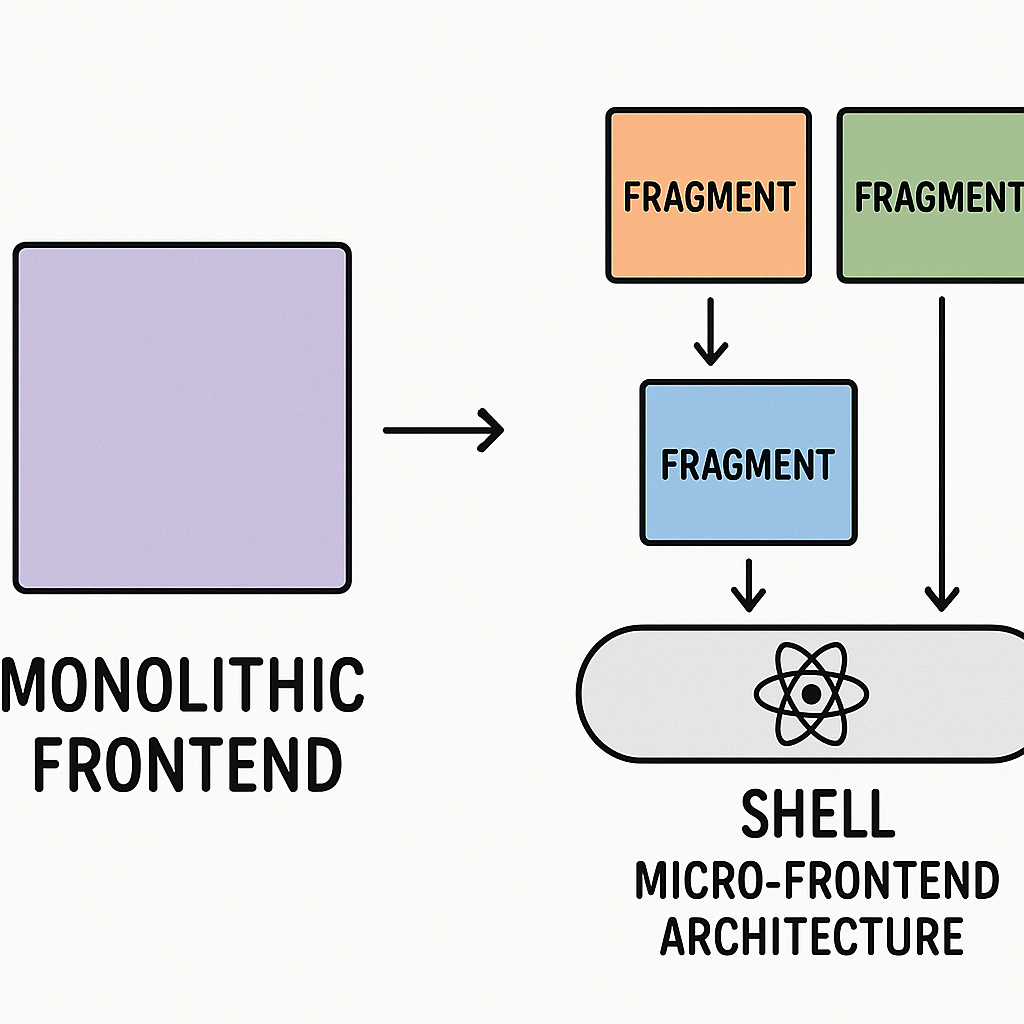
This approach cuts coordination overhead and speeds up feature delivery.
Integrating React with WebAssembly for Performance
WebAssembly (Wasm) brings near-native speeds to the browser. Pairing React’s UI layer with Wasm modules offloads compute-heavy tasks—like image processing or physics simulations—to Rust or C++, while React handles the user interface seamlessly.
Richer web apps without slowing down the main thread.
Code reuse from existing native libraries.
Secure, sandboxed execution.
Learn more about integrating WebAssembly through the MDN's WebAssembly guide .
Building Consistent UI with React-based Design Systems
The React ecosystem has driven the creation of mature design systems that enforce look and feel across products:
Material-UI by Google ( MUI )
Ant Design by Alibaba ( Ant Design )
These libraries offer accessible, themeable components that accelerate development and maintain visual harmony.
Enhancing Accessibility in React Applications
React’s community has championed accessibility (a11y) with tools and patterns:
`react-aria` by Adobe implements WAI-ARIA behaviors in React hooks.
ESLint plugins catch missing labels and roles.
Automated testing tools like Storybook’s a11y addon highlight contrast and semantic issues.
According to WebAIM’s Million Homepage Accessibility Report , 98% of homepages have at least one accessibility error; leveraging React’s a11y libraries helps you do better by default.
Deploying React at the Edge and in Serverless Environments
Modern deployments push React apps closer to users:
Edge Networks (e.g., Cloudflare Pages )
Cache prerendered HTML at data-centers worldwide, cutting latency.
Serverless Backends (e.g., AWS Lambda )
Scale API endpoints on demand without managing servers.
This combination ensures snappy interactions, especially for a global audience.
The Road Forward with React
React’s momentum shows no sign of slowing. Its blend of developer experience, performance features, and expansive ecosystem keeps it at the forefront. By exploring micro-frontends, Wasm integration, robust design systems, a11y best practices, and edge deployments, you’ll be well prepared to harness React’s full power in 2024 and beyond.
:format(webp))
:format(webp))
:format(webp))